

Last Updated: November 1, 2026
Quick Summary
To identify how to identify greenwashing in skincare products, read the label like a skeptic: treat vague words like natural, green, and eco-friendly as decoration, cross-check front claims against the back ingredient list, and demand a named, verifiable certifier with proof. Every strong environmental claim should have a matching proof point on the pack or product page.
- Circle every vague claim on the front; three or more is a warning sign.
- A strong environmental claim needs a matching proof point on the pack or page.
- Trace any certification seal to a named certifying body and its public database.
- A brand-wide certified statement is not the same as a certified bottle.
- Recyclable on a mixed-material pump is technically true and practically misleading.
Table of Contents
- Start With the Label: A Step-by-Step Greenwashing Check
- Skincare Greenwashing Examples You Will Spot in Real Life
- Misleading Skincare Claims: What to Question Before You Buy
- How to Verify Organic Skincare Certification and Its Scope
- Sustainable Skincare Packaging: What the Label Does Not Tell You
- Ingredient Lists and Sourcing: Read Between the Lines
- Build Your Own Claim-Checking Checklist Before You Shop
- Shop Clean Beauty at Penny's Treasure Chest With Confidence
- Frequently Asked Questions
Start With the Label: A Step-by-Step Greenwashing Check
Learning how to identify greenwashing in skincare products starts with one habit: reading the label like a skeptic, not a shopper. Greenwashing is the practice of making a product look more natural, safer, or more eco-friendly than the evidence supports (Green claims - Environment).
Below, we'll show you exactly how to check a bottle in under two minutes. But first, here's what most guides get wrong: they tell you to "look for natural ingredients" without explaining that "natural" is not a regulated term on a skincare label.
Step 1: Scan for Vague Language
Words like "natural," "green," "eco-friendly," and "planet-friendly" carry no fixed legal meaning in most skincare marketing. A brand can print them on almost any bottle. Treat these words as decoration, not evidence.
Circle every vague claim on the front of the pack. If a bottle leads with three or more of them, slow down.
Step 2: Cross-Check the Front and Back of the Pack
The front sells. The back tells. Flip the product over and compare the two sides.
- Front says "botanical blend"? The back should list those botanicals by name.
- Front says "clean"? Look for a definition of what the brand means by it.
- Front shows leaves and flowers? Check whether plant ingredients actually appear in the ingredient list.
If the back panel is thin on detail, the front panel is doing heavy marketing work.
Step 3: Look for Evidence, Not Adjectives
Evidence looks like a certification seal, a named third-party tester, or a full ingredient list with sourcing notes. Adjectives look like "pure," "clean," and "nature-inspired."
A useful rule: every strong environmental claim should have a matching proof point somewhere on the pack or product page. No proof, no trust.
Skincare Greenwashing Examples You Will Spot in Real Life
Real skincare greenwashing examples are easy to spot once you know the patterns. Here are the ones we see most often.
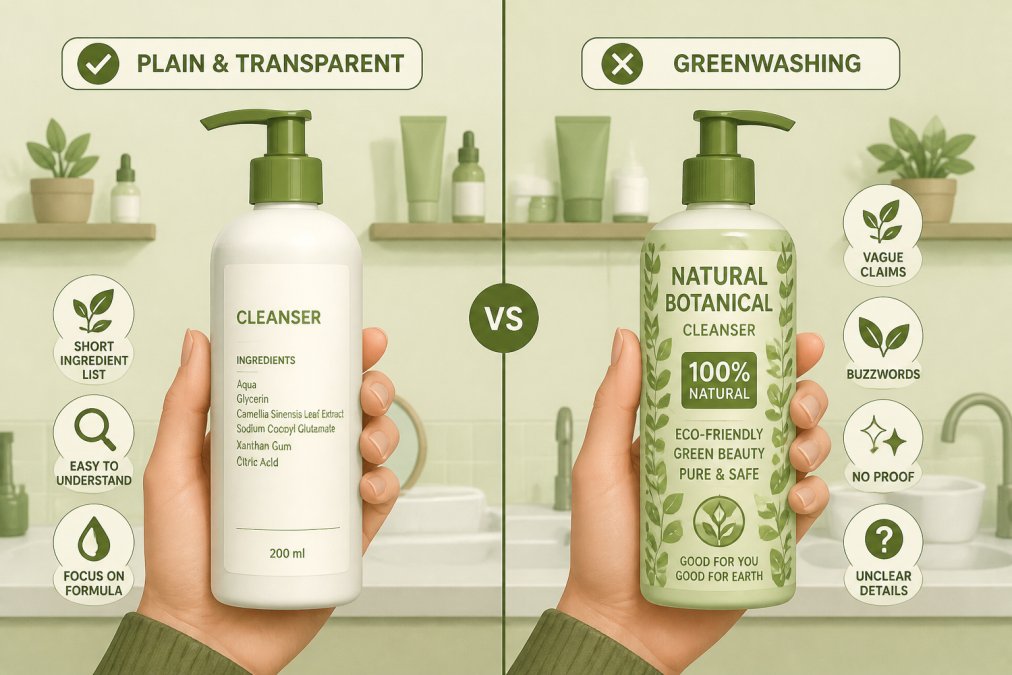
- The leaf-covered bottle. Green packaging and botanical imagery on a product with a mostly synthetic formula.
- The "chemical-free" claim. Everything is a chemical, including water. This claim signals marketing over science.
- The tiny disclaimer. A bold "organic" headline with an asterisk pointing to "contains organic aloe" in small print.
Each of these plays on eco-conscious consumers who want to do the right thing. If you are weighing a gadget purchase, see whether affordable skincare tools are worth it. That intent is good. The marketing around it often is not.
Misleading Skincare Claims: What to Question Before You Buy
Misleading skincare claims usually share one trait: they sound impressive but cannot be checked. Question any claim that fails the "show me" test.
Ask three questions of every product:
- Who verified this? A named third-party body beats a self-designed badge.
- What exactly is covered? "Cruelty-free" may apply to the finished product but not every ingredient supplier.
- Where is the proof? A product page should link to certification details, not just display a logo.
Watch out: a brand can be cruelty-free without being vegan, and vegan without being organic. These claims are separate, and brands often blend them into one green halo.
How to Verify Organic Skincare Certification and Its Scope
Organic skincare certification is only meaningful when you check the certifier and the scope. A seal on the front means little if you cannot confirm which body issued it and what percentage of the formula it covers. Most guides stop at "look for a seal." The useful skill is knowing how to trace that seal back to a public database and read what it actually certifies.
Step 1: Identify the Certifying Body, Not Just the Logo
A legitimate certification names the issuing organization somewhere on the pack or product page, often in small print near the seal or in the FAQ. Common schemes you may encounter include COSMOS (administered by BDIH, Ecocert, Cosmebio, and ICEA), USDA Organic, Ecocert, Natrue, and NSF/ANSI 305.
If the badge has no named body, treat it as decoration. A self-created logo designed to look official is one of the most common greenwashing tactics in skincare.
Step 2: Search the Certifier's Public Database
Most credible certifiers publish a searchable list of certified products or brands. The workflow is consistent:
- Note the exact name of the certifying body on the label
- Go to that body's official website and find its certified-products or brand directory
- Search the brand name, then confirm the specific product name matches, not just the parent company
If the brand does not appear in the certifier's database, the seal is unverified regardless of how official it looks.
Step 3: Distinguish Product-Level from Brand-Wide Claims
This is where most shoppers get tripped up. A certification can apply to:
- A single product, the strongest and most specific form
- A product line or category, narrower than it appears
- A manufacturing facility or process, says nothing about the formula
A brand-wide "we are certified" statement is not the same as a certified bottle in your hand. When the scope is vague, assume the narrower interpretation until the certifier's listing proves otherwise.
Step 4: Read What the Standard Actually Covers
Different schemes certify different things. Some focus on organic content by percentage of ingredients; others cover farming and processing; others address environmental management or packaging.
Look for the certified percentage if the scheme publishes one. If a product claims "organic" but the certifier's standard only requires a small organic fraction, the front label is doing more work than the certificate supports.
Face & Body Coconut Lotion - Pineapple Coconut (12Oz) →
Official consumer protection guidance from bodies like the US Federal Trade Commission stresses that environmental claims must be truthful, specific, and backed by evidence. That principle applies to any market, and it is the standard a certification should meet before you trust it.
Sustainable Skincare Packaging: What the Label Does Not Tell You
Sustainable skincare packaging claims deserve the same scrutiny as ingredient claims. "Recyclable," "biodegradable," and "made with recycled materials" all sound green, but each depends on conditions the label rarely explains. The gap between what a package claims and what actually happens to it after you finish the bottle is one of the largest in skincare greenwashing.
Recyclable Is Not the Same as Recycled
A "recyclable" label means the material is technically capable of being processed, not that your local program will accept it, and not that it will be recycled. Reality depends on:
- Your local rules. Curbside programs vary widely by municipality and country. A tub accepted in one city may be rejected in the next.
- Mixed materials. A pump with a metal spring inside a plastic housing, or a tube with a laminated barrier layer, is hard or impossible to separate. Many programs reject these outright.
- Size. Small sample jars and travel sizes often fall through sorting equipment and are not recovered.
A "recyclable" claim on a mixed-material pump is technically true and practically misleading. Check whether the claim applies to the whole container or only the bottle body. You can also browse body care specialty products where packaging and formulation details matter.
Biodegradable Says Nothing About Time or Place
"Biodegradable" describes a material's ability to break down under specific conditions, but the label rarely states how long it takes or where it breaks down. A formula or package that biodegrades in an industrial composting facility may not biodegrade in a landfill or a home compost bin. Without that context, the word is close to meaningless.
Refillable Only Helps If the System Works
Refillable packaging can genuinely reduce waste, but only if:
- You actually refill it rather than buying a new full-size unit
- The refill packaging is lighter or lower-impact than the original
- The refill is widely available and affordable enough to sustain the habit
A refillable bottle with hard-to-find or expensive refills is a marketing feature more than an environmental one.
Recycled Content: Ask for the Percentage
"Made with recycled materials" is a real claim, but the percentage and material type matter. A bottle with 5% post-consumer recycled content and one with 100% are both "made with recycled materials." Look for a stated percentage and whether it is post-consumer (PCR) or pre-consumer waste. Higher PCR content generally signals a more meaningful commitment.
Check the Whole Lifecycle, Not the Buzzword
Consider the full path of the package:
- Production, what material is used, and how much energy and water it takes to make
- Use, whether the format encourages overuse or waste
- Disposal, whether it can actually be recycled or composted where you live
Ingredient Lists and Sourcing: Read Between the Lines
Ingredient transparency is where greenwashing hides best. A full ingredient list is a good start, but the order and the sourcing details tell the real story.
Ingredients are listed by weight, largest first (Food labelling - general EU rules).
For sourcing, look for:
- Named origins for key ingredients
- Statements about ethical sourcing or supply chain audits
- Clear separation between "contains" and "made with"
A common mistake is assuming a short ingredient list is always cleaner. For a deeper walkthrough, read this guide on how to read supplement ingredient labels.
Build Your Own Claim-Checking Checklist Before You Shop
A claim-checking checklist turns all of this into a repeatable habit. Use this one in the aisle or on a product page.
| Check | What to Look For | Red Flag |
|---|---|---|
| Vague terms | Specific, defined claims | "Natural," "clean," "green" with no detail |
| Front vs back | Matching ingredient detail | Bold claim, thin ingredient list |
| Certification | Named, verifiable certifier | Custom badge, no issuing body |
| Scope | Full formula or single ingredient | Unclear what is covered |
| Packaging | Clear disposal or refill info | "Recyclable" on mixed materials |
| Sourcing | Named origins, ethical notes | No sourcing detail at all |
| Evidence | Linked proof on product page | Claims with no supporting link |
Run this list against three products you already own. Then put your new standards into action with a natural skincare routine for glowing skin. You will likely spot at least one weak claim. That is the point: the skill is in the checking, not in trusting a label.
Shop Clean Beauty at Penny's Treasure Chest With Confidence
Use the ingredient lists and labels on the products you browse to apply everything above.
Here is how we help you shop with confidence:
- Full ingredient lists on products like our Face & Body Coconut Lotion, so you can cross-check every claim
- Affordable pricing that keeps clean beauty within reach, no luxury markup
- A 30-day exchange guarantee if a product is not right for you
Start with the label. Then start with us.
Frequently Asked Questions
What is greenwashing in skincare?
Greenwashing in skincare means a brand makes its product sound more natural, organic, or environmentally friendly than the evidence supports. It often shows up as vague words like natural or eco-friendly on the front label, while the ingredient list or certification record tells a different story. The fix is to treat front-of-pack wording as marketing and check the back label, the certifying body, and the ingredient list before you buy.
How can you tell if a skincare product is greenwashed?
Run a three-step check. First, scan for vague terms such as natural, green, or planet-friendly that have no standard definition. Second, look for a named certification with a logo and a certifying body you can look up, not a self-designed badge. Third, compare the front claim with the ingredient list and the packaging disposal instructions. If the front says organic but no certifier is named, or the bottle says recyclable but the pump is mixed plastic, treat the claim as unproven.
How do you verify a skincare product's organic or natural claims?
Ask which certifier, which standard, and which scope. A real organic skincare certification names the body that issued it and the percentage of organic ingredients covered. Look up the certifier's public register and confirm the product or brand appears there. For natural claims, check whether the brand defines the word on its site and whether the ingredient list backs it up. A product can contain one organic oil and still be mostly synthetic, so read the full list, not just the headline ingredient.
Are green skincare labels and certifications always trustworthy?
No. Some logos are invented by the brand itself and carry no third-party verification. Others are real but narrow: a certification may cover only one ingredient, one facility, or one part of the supply chain, not the whole product. Before trusting a badge, find the issuing organization, read what the standard actually measures, and check that the product is listed. If you cannot find the certifier's name or a public listing, do not count the badge as evidence.
Greenwashing survives because most shoppers never flip the bottle over. You now know how to check vague language, verify certifications, question packaging claims, and read ingredient lists with a sharper eye. Penny's Treasure Chest makes that easier with full ingredient transparency, fair prices, and a 30-day exchange guarantee on every order. Get started with Penny's Treasure Chest and build a clean beauty routine you can actually verify.


