

Table of Contents
- Why Reading Supplement Labels Matters
- How to Read a Supplement Facts Label: Step-by-Step
- Decoding a Proprietary Blend Supplement Label
- What Does USP Verified Supplement Meaning Tell You?
- Supplement Label Examples: Real-World Walkthrough
- Ingredient Forms, Standardization, and Extract Ratios
- Label Red Flags and When to Consult a Professional
- Frequently Asked Questions
Last Updated: October 19, 2026
Why Reading Supplement Labels Matters
Learning how to read supplement ingredient labels is the fastest way to know what you are actually swallowing.
At Penny's Treasure Chest, we see the same problem again and again. Shoppers buy on the front label, where words like "energy" and "glow" live. The back label, where the facts live, gets skipped.
A supplement label is a regulated information panel. In the United States, the FDA rules for dietary supplement labeling set out exactly what must appear and where.
Here is what most guides get wrong: they treat the label as one block of text. It is really three separate puzzles. First, the serving size. Second, the ingredient amounts. Third, the fine print.
Below, we walk through each part with a real example. You will also learn the red flags that should make you put a bottle back on the shelf.
How to Read a Supplement Facts Label: Step-by-Step
Start at the top of the Supplement Facts panel and work down. The top tells you how much counts as one serving. The middle tells you what is in that serving. The bottom tells you what else is in the capsule or powder.
That order matters. A big number in the middle means nothing until you know the serving size.
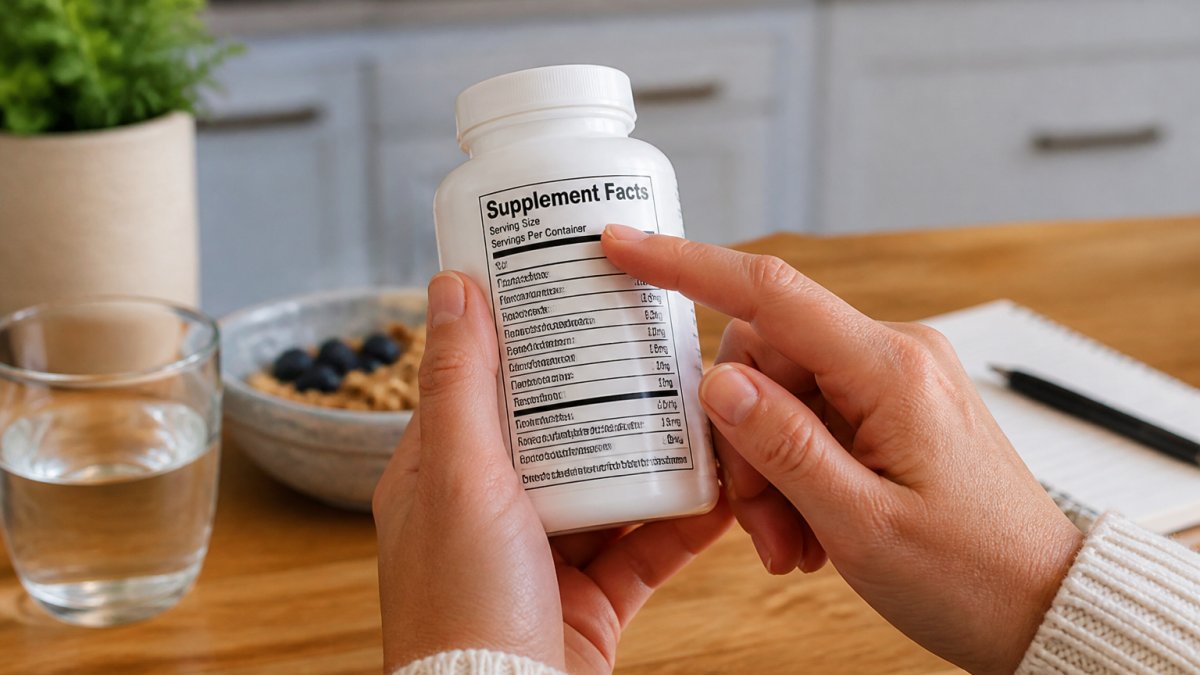
Serving Size and Servings Per Container
The serving size is the amount you must take to get the numbers on the label. It might be one capsule, two capsules, or one scoop.
Servings per container tells you how long the bottle lasts. This is where quiet math happens. A bottle with 60 capsules and a serving size of two capsules is a 30-day supply, not 60 days.
Check this before you compare prices. A cheaper bottle with half the servings is not cheaper at all.
Amount Per Serving and %DV
Amount per serving is the quantity of each dietary ingredient in one serving. It appears in weight, usually milligrams (mg) or micrograms (mcg).
Next to it sits the Percent Daily Value (%DV). The %DV shows how much of a nutrient one serving provides, based on a standard daily intake. A %DV of 50% means one serving gives you half of that daily reference amount.
Two things to keep in mind:
- %DV exists mainly for vitamins and minerals. Herbs and botanicals often show no %DV at all.
- A high %DV is not automatically better. It depends on what your body needs and what else you take.
Other Ingredients and Allergen Information
The "Other Ingredients" list sits below the dietary ingredients. These are the fillers, binders, capsules, and flavorings. They are not active, but they still go into your body.
Read this list if you have allergies or a sensitive gut. Common entries include gelatin, cellulose, magnesium stearate, and silica.
Federal rules also require allergen labeling when a major allergen is present. If you react to soy, dairy, or gluten, check this line every time, even on repeat orders. Formulas change.
Decoding a Proprietary Blend Supplement Label
A proprietary blend supplement label hides the dose of each herb. You will see a total amount, then a list of ingredients in parentheses with no numbers beside them.
Here is what that means in practice.
Why blends exist at all comes down to two things. First, formula protection: a maker does not want a competitor to copy an exact ratio.
Blends are not automatically bad. Some makers use them to protect a formula. But you cannot judge whether each herb matches the studied amount.
A useful comparison method is to line up a blend product against a single-ingredient product side by side. Ask three questions:
- What is the total blend weight? If the whole blend is 300 mg and it contains six ingredients, the average share is 50 mg, and the smallest share is likely far less.
- What is the first ingredient? Listing order is by weight, so the lead ingredient is the largest share. If the herb you want is last, it is the smallest.
- Is the ingredient you care about also sold as a standalone? If so, the standalone label gives you a number you can actually compare against a studied dose.
Our advice: if a specific herb is the reason you are buying, pick a product that states its amount outright.
One more label-reading habit: blends sometimes appear alongside a separate, fully disclosed ingredient. Read the panel line by line rather than assuming the whole formula is hidden.
What Does USP Verified Supplement Meaning Tell You?
The USP Verified supplement meaning is simple: an independent group has checked that product against a set of quality standards. USP verifies identity, strength, purity, and how the product is made.
Magnesium Complex Supplement - 1000Mg →
That matters because supplements are not pre-approved for safety the way drugs are. The FDA's consumer guidance on dietary supplements notes that manufacturers are responsible for safety and labeling before sale. Third-party checks add a layer the label alone cannot give you.
Look for the USP Verified Mark on the bottle. Other independent programs exist too, and each has its own standards. The key question is whether the check is done by an outside lab, not by the brand itself.
One honest limit: a seal confirms quality, not whether the product suits you. It says nothing about your personal needs or interactions.
Supplement Label Examples: Real-World Walkthrough
Most guides explain the panel in pieces. This section puts the pieces together on one realistic label, read top to bottom, the way you would actually do it in a store aisle.
Picture a magnesium bottle. The panel reads: serving size, two capsules. Servings per container, 30. Amount per serving, 1000 mg of a magnesium blend.
Now read it the way we teach, one line at a time.
- Serving size, two capsules, not one. The 1000 mg applies to the pair. If you take one capsule, you are getting roughly half the label's numbers, and the bottle lasts twice as long as the servings-per-container line suggests at the stated dose. This is the single most common misread on a supplement panel.
- Servings per container, 30. At two capsules a day, the bottle is a one-month supply. Divide the capsule count by the serving size to check: 60 capsules ÷ 2 = 30 servings. Do this before comparing prices, because a larger bottle with a larger serving size can cost more per day than a smaller one.
- Amount per serving, 1000 mg total. Note the word "blend." The 1000 mg is the combined weight of every magnesium form listed, not 1000 mg of each. The forms named in parentheses, glycinate, citrate, malate, taurate, orotate, are listed by weight, so the first is the largest share and the last is the smallest.
- Ingredient forms. Different forms absorb differently and have different tolerability profiles. Magnesium oxide is common and inexpensive but poorly absorbed by many people; glycinate and citrate are chosen for absorption and gentler digestion. The label tells you which forms are present but not the split, which is the blend limitation described above.
- Other ingredients. Vegetable cellulose is the capsule shell. Magnesium stearate and silica are common flow agents used in manufacturing. They are not active ingredients, but they are on the label because they go into your body. If you have a sensitive gut or an allergy, this is the line to read every time.
- Directions for use. "Two capsules daily with food" is the maker's instruction. Follow the label rather than a friend's advice or a social media post, because the serving size and the directions are designed to match.
- Warnings. The pregnancy, nursing, and medication line is not boilerplate to skip. It is the maker telling you which groups should check with a clinician first.
That is the whole method. Read the top, read the middle, read the bottom, then decide. The same seven-step pass works on a multivitamin, a probiotic, or a protein powder, only the specific lines change.
You can practice on any product, including our Magnesium Complex Supplement - 1000Mg.

Ingredient Forms, Standardization, and Extract Ratios
The form of an ingredient can matter as much as the amount. Magnesium oxide and magnesium glycinate are both magnesium, but they behave differently in the body. The same logic applies to vitamins and herbal extracts.
Standardization is the label's way of saying a batch was adjusted to hit a target level of a key compound. A standardized extract gives you a more predictable amount from bottle to bottle.
Extract ratios work differently. A ratio like 10:1 means ten parts of raw herb went into one part of extract. It sounds impressive, but a high ratio does not prove quality. It only describes how concentrated the material is.
What most guides miss: none of these terms are magic words. They are tools for comparison. Put two bottles side by side and ask which one tells you more about what is inside.
Label Red Flags and When to Consult a Professional
Some labels are built to mislead without breaking a rule. Watch for these:
- Tiny serving sizes. A "500 mg" dose that turns out to be per quarter-scoop.
- Vague blends. Long ingredient lists with no individual amounts.
- Missing contact details. No manufacturer name or address is a bad sign.
- Front-label hype. Words like "miracle" or "guaranteed" that the panel never backs up.
- No directions for use. A serious product tells you how to take it.
Then there is the safety side. Supplements can interact with prescription drugs. The NIH Office of Dietary Supplements fact sheets are a plain-language place to check a specific ingredient.
Talk to a pharmacist or clinician before starting anything new if you take medication, are pregnant or nursing, or manage a health condition. That is not a disclaimer.
If a product causes a bad reaction, report it. The FDA's MedWatch reporting program exists for exactly this, and reports help flag problems for everyone else.
Reading a supplement label is a skill, and it takes about thirty seconds once you have it. The front sells. The panel informs. Learn to read the panel and you stop paying for hype.
At Penny's Treasure Chest, we built our shelves around that idea.
Ready to shop with a clearer eye? Browse our collections and read the panel on every bottle.
Frequently Asked Questions
What is the difference between Supplement Facts and an ingredient list?
The Supplement Facts panel is the standardized box that lists serving size, amount per serving, and percent Daily Value for each dietary ingredient. The ingredient list (often called 'Other Ingredients') appears below and covers inactive components like fillers, binders, and flavorings. Both matter: the Facts panel tells you what active nutrients you get, while the ingredient list reveals what else is in the capsule or powder. Always read both before buying.
What does USP Verified mean on a supplement label?
USP Verified is a third-party certification from the U.S. Pharmacopeial Convention. It confirms the product contains the ingredients listed on the label in the declared amounts, does not contain harmful levels of contaminants, will break down properly in the body, and was made in a facility that follows good manufacturing practices. Look for the USP Verified Mark, not just the words 'USP' or 'quality seal,' which can be used without certification.
How can I tell how much of an ingredient is in a proprietary blend?
You often cannot. A proprietary blend supplement label lists the total weight of the blend but not the amount of each individual herb or extract. If the blend is 500 mg and contains five ingredients, you have no way to know if one ingredient is 400 mg and the others are 25 mg each. For ingredients where dose matters, choose products that disclose individual amounts rather than hiding them in a blend.
What symbols or seals should I look for on supplements?
The most reliable seals are USP Verified, NSF Certified, and Informed Choice/Informed Sport. These require third-party testing for potency, purity, and contaminants. A GMP seal indicates manufacturing standards but not product testing. Be cautious of in-house 'quality seals' that are not backed by an independent organization. When comparing supplement label examples, check whether the seal comes from a recognized certifier or from the brand itself.


