

Last Updated: October 26, 2026
Quick Summary
Comparing earthley vs garden of life supplements comes down to formulation, testing disclosure and cost per serving. Earthley is a small, herb-first brand focused on tinctures and whole-food blends, while Garden of Life is a large-scale brand with broad multivitamin and probiotic lines. Neither brand publishes lot-level certificates of analysis for most products, so treat certification seals as a starting point rather than proof of potency.
- Garden of Life carries USDA Organic and Non-GMO Project seals on many or select products.
- Earthley emphasizes small-batch production, herbal sourcing and short ingredient lists.
- Calculate cost per serving by dividing bottle price by servings per bottle, not capsule count.
- Anyone pregnant, breastfeeding or on prescription drugs should consult a clinician before starting either brand.
- Ask the seller for a certificate of analysis before buying any specific product.
Table of Contents
- Earthley vs Garden of Life: Two Approaches to Supplement Quality
- Brand Overview: Earthley and Garden of Life Product Ranges
- How to Read Supplement Ingredient Labels on Both Brands
- Third-Party Tested Supplements: What Each Brand Discloses
- Herbal Multivitamin vs Regular Multivitamin: Which Fits Your Routine
- Supplement Cost per Serving: Comparing Earthley and Garden of Life
- Safety, Interactions, and Who Should Consult a Clinician
- Choosing Your Earthley or Garden of Life Supplements at Penny's Treasure Chest
- Frequently Asked Questions
Earthley vs Garden of Life: Two Approaches to Supplement Quality
Earthley and Garden of Life both sell dietary supplements built around natural ingredients, but they come at the category from opposite directions. Earthley is a small, herb-first operation focused on tinctures, salves and whole-food blends.
At Penny's Treasure Chest, we hear questions about label transparency and value. Below, we break down both brands section by section so you can decide which approach fits your routine.
Brand Overview: Earthley and Garden of Life Product Ranges
Earthley's catalog leans toward herbal extracts, elderberry syrups, magnesium products and small-batch wellness staples. Its identity is built on short ingredient lists and herbal ingredients rather than long vitamin panels.
Garden of Life covers more ground: multivitamins, probiotics, protein powders, and women's health formulations. That breadth suits shoppers who want one brand for several needs. The trade-off is that a large catalog makes label reading more work, because formulations vary widely across the range.
- Earthley: herbal-focused, smaller range, tincture and syrup formats
- Garden of Life: broad range, multivitamin and probiotic heavy, capsule and powder formats
- Best for Earthley: shoppers who prefer herbal ingredients over synthetic vitamin blends
How to Read Supplement Ingredient Labels on Both Brands
The fastest way to compare these two brands is to read the Supplement Facts panel line by line. Start with serving size, then check whether the vitamins and minerals are listed as whole-food ingredients or isolated compounds, and finish with the "other ingredients" list.
Three checks separate a strong label from a weak one:
- Serving size versus dose. A label can list a nutrient but supply a small fraction of it per capsule.
- Forms of nutrients. Look for chelated minerals and active vitamin forms rather than oxides.
- Additives. Watch for added sugars, fillers and allergens in the "other ingredients" line.
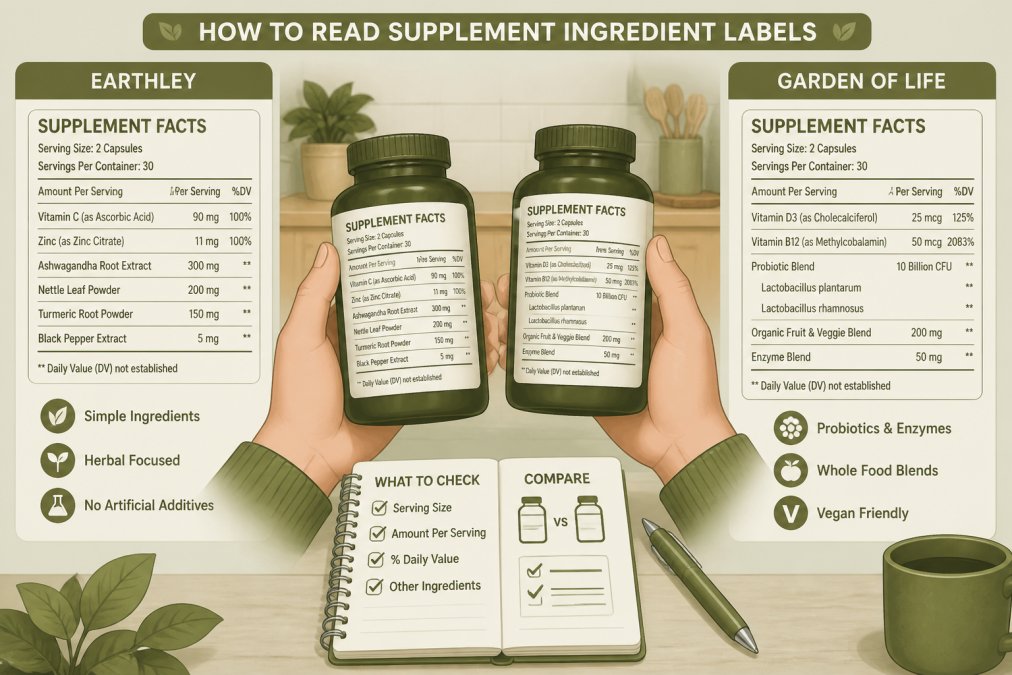
For a full walkthrough of decoding these panels, see our guide on how to read supplement ingredient labels.
Third-Party Tested Supplements: What Each Brand Discloses
Third-party tested supplements are products verified by an outside lab for potency and purity, not just by the manufacturer. This is where the two brands diverge most in how much they publish, and where most comparison articles stay vague. Here is the concrete version.
What Garden of Life discloses
Garden of Life's public quality story rests on three pillars you can actually verify on a label or its website:
- Organic certification. Many Garden of Life multivitamins and powders carry USDA Organic seals, which means an accredited certifier, not the brand, has audited the ingredients and processing against the USDA National Organic Program standards. That is a real, checkable claim, but note what it does not cover: organic certification says nothing about whether the vitamin doses match the label.
- Non-GMO Project verification. A subset of Garden of Life products carry the Non-GMO Project butterfly seal, which is an independent verification of GMO avoidance in the supply chain. Again, useful for sourcing, silent on potency.
- GMP facility claims. Garden of Life states that its products are manufactured in cGMP-compliant facilities. Current Good Manufacturing Practice is an FDA-enforced baseline for all supplement manufacturers, so this is a floor, not a differentiator, treat it as table stakes rather than a quality badge.
What Garden of Life does not publish consistently is a product-by-product certificate of analysis (COA) with lot-level potency results. Some brands in this space do; Garden of Life generally does not put COAs on its consumer-facing site.
What Earthley discloses
Earthley's transparency story is different in kind. The brand emphasizes small-batch production, herbal sourcing, and short ingredient lists, and it publishes ingredient sourcing information for many products. That is genuinely useful, but it is sourcing transparency, not analytical testing transparency. Earthley does not publish third-party COAs for most products on its site either.
The certification comparison, side by side
| What is verified | Garden of Life | Earthley |
|---|---|---|
| USDA Organic seal on many products | Yes | Varies by product |
| Non-GMO Project verification | Yes, on select products | Not a primary claim |
| cGMP facility manufacturing | Stated | Stated |
| Lot-level COA published publicly | Generally no | Generally no |
| Ingredient sourcing detail | Moderate | Strong for many products |
What this means for you
Neither brand gives you a full, product-by-product testing disclosure, so treat certification logos as a starting point, not proof of potency. The FDA's guidance on dietary supplement labeling explains what manufacturers are and are not required to put on a label, and potency verification is not on the required list.
If independent verification matters to your routine, prioritize the products that carry a named third-party seal (USDA Organic, Non-GMO Project) over products that only claim 'lab tested' in marketing copy, the seal is auditable, the phrase is not.
Herbal Multivitamin vs Regular Multivitamin: Which Fits Your Routine
A herbal multivitamin blends vitamins with botanical ingredients, while a regular multivitamin delivers vitamins and minerals alone.
Neither format is automatically better. If you want help weighing the herbal side, our guide on how to choose effective herbal supplements covers what to look for.
A common mistake is buying a herbal multivitamin for the botanicals and then discovering the vitamin doses are too low to matter. Check the numbers first.
Supplement Cost per Serving: Comparing Earthley and Garden of Life
Cost per serving, not bottle price, is the honest way to compare these brands, and it is the comparison almost no one actually does. Here is how to run it yourself, with the product categories where the two brands overlap most.
The formula
Cost per serving = bottle price ÷ number of servings per bottle.
Two traps to avoid:
- Serving size ≠ capsule count. A bottle of 60 capsules with a 2-capsule serving is 30 servings, not 60. Always divide by servings, not pills.
- Label serving vs. your serving. If you take two servings a day to hit a meaningful dose, your real cost per day is double the label figure.
Where the two brands actually compete on price
The overlap is narrower than the brand pages suggest. Earthley's catalog is dominated by tinctures, syrups, and herbal powders; Garden of Life's is dominated by multivitamins, probiotics, and protein powders. The categories where a fair cost-per-serving comparison exists are:
- Daily multivitamin. Garden of Life's multivitamin lines are the direct comparison point; Earthley's whole-food blends are the closest equivalent. Compare servings per bottle, not bottle size.
- Probiotic / digestive support. Garden of Life's probiotic lines are the benchmark here; Earthley's digestive offerings are herbal rather than live-culture, so the products are not directly equivalent, note that before comparing price.
- Magnesium. Both brands offer magnesium in some form; check the elemental magnesium per serving, because a chelated form delivering less elemental magnesium per capsule can look cheaper per bottle while costing more per milligram absorbed.
A worked example of the method
Suppose Brand A sells a 60-capsule multivitamin at a 2-capsule serving for $X, and Brand B sells a 30-serving powder for $Y. The comparison is not $X vs. $Y, it is ($X ÷ 30) vs. ($Y ÷ 30). Run that math on the current listings before you decide; the cheaper bottle is frequently the more expensive daily habit.
The value question competitors skip
A larger bottle often lowers cost per serving, but only if you will finish it before it expires, and only if the dose is one you will actually take daily.
Our advice: build a two-column note, product, servings per bottle, cost per serving, and label dose, for the two or three products you are actually considering. That four-line table will tell you more about value than any brand reputation claim.
Safety, Interactions, and Who Should Consult a Clinician
Herbal and whole-food supplements can interact with medications, so safety deserves a direct answer. Anyone who is pregnant, breastfeeding, taking prescription drugs, managing a chronic condition, or scheduled for surgery should speak with a clinician before starting either brand.
Specific points to raise with your doctor:
- Herbal ingredients such as elderberry or adaptogens and how they interact with your current medications
- Total vitamin and mineral intake if you already take a multivitamin
- Any allergens listed on the label
The NIH Office of Dietary Supplements fact sheets are a practical, plain-language reference for checking individual ingredients. Watch out: doubling up on multivitamins and single-nutrient products is an easy way to exceed safe intake without noticing.
Choosing Your Earthley or Garden of Life Supplements at Penny's Treasure Chest
Decide based on your routine, not the brand name. If you want herbal ingredients and simple formats, Earthley fits. If you want certified organic multivitamins and probiotics under one label, Garden of Life fits.
At Penny's Treasure Chest, we curate herbal powders, adaptogenic drink mixes and clean wellness essentials with the same label-first approach, at accessible prices. If you are building out a gut-health or energy routine, our roundup of affordable gut-health supplement picks is a good next stop.
Frequently Asked Questions
Is Earthley a reputable supplement brand?
Earthley is a smaller brand that focuses on herbal and whole-food ingredients, but its reputation depends on what you value. Check whether the label lists specific plant parts and amounts, and whether the brand publishes third-party test results. Without independent testing data, treat any brand's claims as unverified. Compare the supplement facts panel and serving size rather than relying on marketing language, then decide if the formulation matches your needs.
Is Garden of Life a good vitamin brand?
Garden of Life is a larger brand with a wide range of multivitamins, probiotics, and whole-food formulas. Many of its products carry organic certifications and list whole-food ingredients on the label. Quality still varies by product, so read the supplement facts panel and check for third-party testing seals. Look at the dosage per serving and cost per serving to see if it fits your budget and routine before committing to a full bottle.
What should I look for on a supplement ingredient label?
Start with the supplement facts panel: check the serving size, the amount of each active ingredient, and whether the label lists whole-food or herbal ingredients with specific plant parts. Look for third-party testing seals and certifications like organic or non-GMO. Avoid proprietary blends that hide individual doses. Also scan for added sugars, allergens, and fillers. A clear label with transparent dosing makes it easier to compare brands like Earthley and Garden of Life.
How can I compare the cost per serving of supplements?
Divide the total bottle price by the number of servings, not the number of capsules. Check the serving size on the label because some brands require two or three capsules per serving. For example, a 60-capsule bottle with a two-capsule serving provides 30 servings. Compare that cost per serving across brands and formats, including powders and liquids. This method gives a fair comparison between Earthley and Garden of Life products with different bottle sizes.
The supplement aisle rewards patience, not brand loyalty. Read the label, check the dose, and ask for testing documentation before you commit.
Penny's Treasure Chest handpicks premium supplements and clean beauty essentials, offers free shipping on orders over $200, and backs every order with a 30-day exchange guarantee plus 24/7 online support. Get started with Penny's Treasure Chest and build a wellness routine you can actually keep.


