

Table of Contents
- Why a Natural Skincare Routine Delivers Glowing Skin
- The 7-Step Order for a Natural Skincare Routine
- Your Natural Morning Skincare Routine
- Your Natural Evening Skincare Routine
- A Natural Skincare Routine for Sensitive Skin
- Clean Beauty Product Ingredients to Look For (and Avoid)
- Realistic Timelines, Common Mistakes, and When to See a Pro
- Frequently Asked Questions
Last Updated: October 18, 2026
Why a Natural Skincare Routine Delivers Glowing Skin
A natural skincare routine is a daily sequence of cleansing, toning, treating, moisturizing, and protecting steps built around plant-based ingredients rather than synthetic fillers.
At Penny's Treasure Chest, we hear the same frustration from customers: they buy five products, use them randomly, and see nothing change. Order matters more than the number of bottles on the shelf. So does patience.
Skin biology backs this up. The American Academy of Dermatology's guidance on face washing notes that gentle cleansing twice daily, plus moisturizer and sun protection, forms the foundation of healthy skin at any age. Everything else is refinement.
The 7-Step Order for a Natural Skincare Routine
The correct order runs thinnest to thickest: cleanse, tone, exfoliate, treat, moisturize, protect, and mask weekly. Applying products in this sequence lets each layer absorb instead of sitting on top of the last one.
Here is the full sequence at a glance:
| Step | Product | Frequency | Why It Matters |
|---|---|---|---|
| 1 | Gentle cleanser | Twice daily | Removes dirt without stripping |
| 2 | Alcohol-free toner or mist | Twice daily | Restores hydration after washing |
| 3 | Exfoliant | 2-3 times weekly | Clears dead skin cells |
| 4 | Serum | Twice daily | Delivers targeted treatment |
| 5 | Moisturizer | Twice daily | Locks in water, supports barrier |
| 6 | SPF | Every morning | Prevents UV damage and dullness |
| 7 | Face mask | Once weekly | Extra hydration or clay detox |
Step 1: Gentle Cleansing
Start with a cream cleanser or oil cleanser if your skin feels tight after washing. Foaming face wash suits oily skin, but most people over-cleanse. Rinse with lukewarm water, use circular motions for about 30 seconds, and pat dry rather than rubbing.
Step 2: Tone and Mist
An alcohol-free toner or facial mist replaces some of what cleansing takes away. Hydrosols, the water left after distilling plants, work well here. Apply with clean hands or a cotton pad while skin is still slightly damp.
Step 3: Exfoliate (2-3 Times a Week)
Chemical exfoliants remove dead skin cells more evenly than scrubs. Natural options include oatmeal and finely milled rice powder; kaolin clay draws out excess oil. Two to three sessions weekly is enough. More frequent exfoliation thins the barrier and causes redness.
Step 4: Treat With Serums
This is where targeted treatment lives. Our 3-in-1 Face Serum Set pairs vitamin C for morning brightening with hyaluronic acid and retinol for evening renewal, at $24.99 for all three. Start retinol two to three nights a week and build up.

Step 5: Moisturize
A moisturizer with plant-based ingredients seals in hydration. Our Face & Body Coconut Lotion uses cold-pressed coconut oil with apricot kernel and avocado oils to nourish dry skin. Apply while skin is still damp for better absorption.

Step 6: Protect With SPF
Sun protection is non-negotiable, even indoors near windows and even in winter. UV exposure breaks down collagen and drives the dullness people mistake for "needing a stronger serum." Apply SPF as the final morning step, and reapply if you're outside for long stretches.
Step 7: Weekly Face Mask
Once a week, add a face mask: hydrating for dry or sensitive skin, kaolin-based for oily or combination skin. Ten to fifteen minutes is plenty. This is the step most people skip, and it's the easiest one to enjoy.
Your Natural Morning Skincare Routine
A natural morning skincare routine should be short: cleanse, mist, serum, moisturize, and SPF, in that order, completed in under five minutes. Mornings are for protection and prep, not repair.
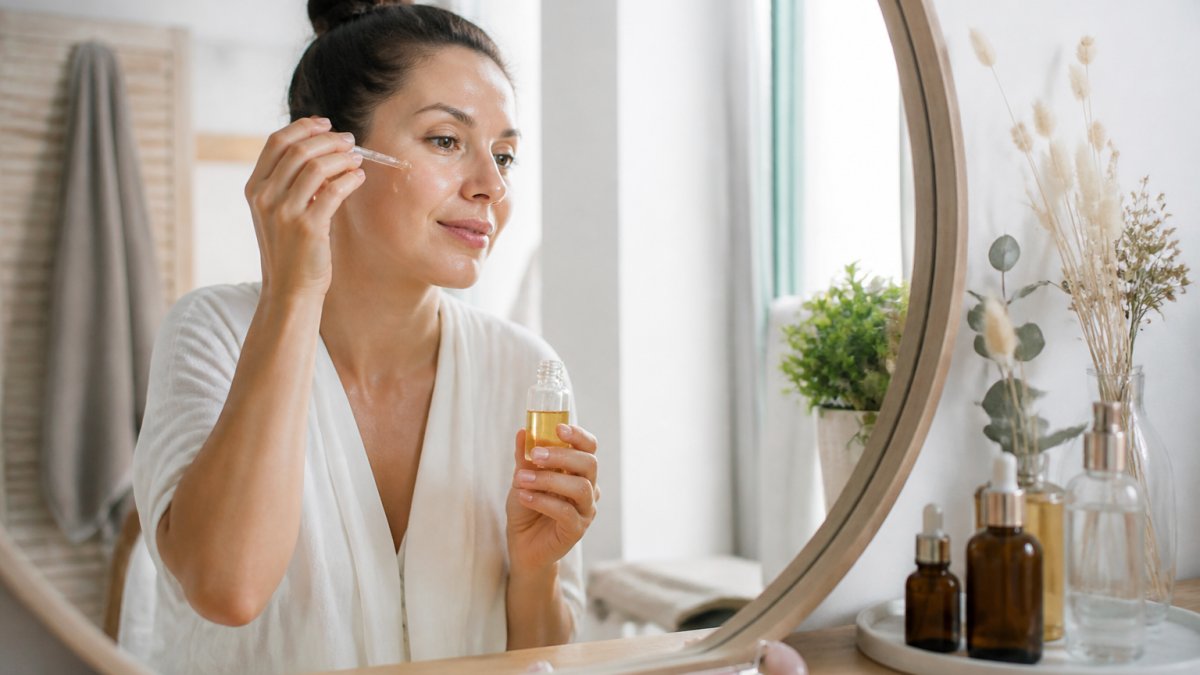
Keep it lean. Vitamin C serum in the morning supports brightness and defends against environmental stress. Follow with moisturizer, then SPF. If your skin looks puffy, a cooling tool helps more than another product.
Our Facial Ice Roller & Massager fits neatly between cleansing and serum. Roll upward and outward for one to two minutes to reduce puffiness and tighten the look of pores.

Your Natural Evening Skincare Routine
An evening routine shifts from protection to repair: cleanse, exfoliate on scheduled nights, treat, and moisturize more heavily than you do in the morning. Skin renews overnight, so this is where actives earn their keep.
Apply hyaluronic acid first, then retinol, then a night cream. If your skin feels tight, add a facial oil or balm as the final layer. Skip exfoliation on retinol nights to avoid overloading the barrier.
A Natural Skincare Routine for Sensitive Skin
A natural skincare routine for sensitive skin means fewer products, fragrance-free formulas, and patch testing every new item for 48 hours behind the ear or on the inner forearm. Sensitivity is a signal to simplify, not to add more.
3-in-1 Face Serum Set — Hyaluronic Acid, Retinol & Vitamin C →
The sensitive-skin baseline:
- Cleanse once daily with a cream or lotion cleanser, and rinse with lukewarm water only in the morning. Over-cleansing is the most common trigger for reactive skin.
- Skip toner unless it is a simple hydrosol or glycerin-based mist with no alcohol, fragrance, or essential oils.
- Exfoliate rarely, once weekly at most, using a gentle lactic acid or oatmeal-based product rather than scrubs or strong acids.
- Choose one treatment serum built on peptides, hyaluronic acid, or colloidal oatmeal rather than retinol or vitamin C if your skin reacts easily.
- Moisturize with a short ingredient list, five to ten ingredients is a reasonable target, and apply while skin is damp.
- Use a mineral SPF (zinc oxide or titanium dioxide) if chemical filters sting or cause redness.
Watch for reactions to essential oils, which are natural but can still irritate. Our Silk Peptide Lifting Serum is fragrance-free and built on peptides, collagen, and silk proteins rather than harsh actives, which makes it a gentler starting point for skin that reacts easily.
Patch testing method that actually works: Apply a small amount of the new product to the inner forearm or behind the ear, twice daily for 48 to 72 hours. If no redness, itching, or swelling appears, introduce it to your face, one product at a time, with at least a week between new additions. Keep a simple note of what you added and when. This is slower than most people want, but it is the only reliable way to identify a trigger.
When sensitive skin needs more than a routine: Persistent redness, burning, or reactions that don't settle after removing a product may point to rosacea, eczema, or contact dermatitis. A dermatologist can help distinguish a routine problem from a medical one.
Clean Beauty Product Ingredients to Look For (and Avoid)
Clean beauty product ingredients fall into two groups: what supports the barrier and what undermines it. But "natural" is not a safety or efficacy guarantee, poison ivy is natural, and many plant extracts are untested for long-term topical use.
Ingredients with reasonable evidence behind them:
- Glycerin, a humectant that draws water into the skin; one of the most studied and reliable moisturizing ingredients.
- Hyaluronic acid, holds water in the upper skin layers; effective for temporary plumping and hydration.
- Niacinamide, supports the barrier, moderates oil, and can reduce the look of redness; well tolerated by most skin types.
- Colloidal oatmeal, soothes irritation and supports the barrier; recognized in dermatology for eczema-prone skin.
- Plant oils rich in linoleic acid (e.g., sunflower, safflower, rosehip), support the barrier without heavy occlusion; better for oily and combination skin than coconut oil.
- Vitamin C (L-ascorbic acid), antioxidant support and brightness; best in a stable, well-formulated product, as it degrades with light and air.
Ingredients to question, not necessarily avoid, but understand:
- Essential oils, natural but a common source of contact irritation and allergy; lavender, citrus, peppermint, and eucalyptus are frequent culprits.
- Coconut oil, occlusive and comedogenic for some; fine for dry body skin, less reliable on acne-prone faces.
- Drying alcohols (denatured alcohol, SD alcohol) high in an ingredient list, can strip the barrier with repeated use.
- "Fragrance" or "parfum", an umbrella term that can hide dozens of compounds; a common trigger for sensitive skin.
- "Chemical-free" claims, water is a chemical; this phrase is marketing, not science.
The FDA's cosmetics labeling requirements explain why ingredient lists are your best verification tool: products must declare ingredients in descending order of concentration. Read the first five. "Natural" on a label is marketing; the ingredient list is evidence.
A practical rule: If a product's first five ingredients are water, glycerin, a plant oil, a humectant, and a barrier-supporting agent, it is likely a reasonable foundation. If the first five are water, alcohol, fragrance, and two extracts with no explanation, be skeptical.
Realistic Timelines, Common Mistakes, and When to See a Pro
Expect hydration to improve within a week, texture and tone within four to six weeks, and firmness changes over two to three months. Anyone promising overnight glow is selling, not advising.
The mistakes we see most often:
- Over-exfoliating. Daily scrubs strip the barrier and cause redness. Two to three times weekly is the ceiling.
- Skipping SPF. No serum outruns unprotected sun exposure.
- Mixing actives carelessly. Retinol and strong acids on the same night invites irritation.
- Judging too soon. Four weeks is the minimum before deciding a product doesn't work.
See a dermatologist for persistent acne, sudden changes in a mole, or reactions that don't settle. A routine supports skin health; it doesn't replace medical care.
Frequently Asked Questions
What is a good natural skincare routine for glowing skin?
A simple routine that cleanses, tones, treats, moisturizes, and protects every day. In the morning use a gentle cleanser, an alcohol-free toner, a vitamin C serum, a moisturizer, and SPF. At night, cleanse again, exfoliate two or three times a week, and apply a retinol or peptide serum before your night cream. Consistency matters more than the number of products, and a natural skincare routine can stay under five steps and still deliver a visible glow.
Should I use a different natural skincare routine in the morning and at night?
Yes. Your natural morning skincare routine should focus on protection and brightness: vitamin C, hydration, and SPF. Your natural evening skincare routine shifts to repair: cleansing off sunscreen and makeup, exfoliating two or three times a week, and using retinol or peptides while your skin renews overnight. Splitting actives this way lowers the risk of irritation and lets each ingredient do its job at the right time of day.
Can natural skincare products irritate sensitive skin?
They can. Essential oils, citrus extracts, and some botanical fragrances trigger reactions even in products labeled clean. If you have sensitive skin, patch test any new product on your inner forearm for 48 hours before applying it to your face. Look for short ingredient lists, fragrance-free formulas, and staples like oatmeal, kaolin, and glycerin. Introduce one new product at a time so you can tell what caused a reaction if one appears.
How long does it take for a natural skincare routine to show results?
Expect four to six weeks for hydration and texture to improve, and eight to twelve weeks for fine lines, tone, and firmness. Skin cell turnover runs on a roughly 28-day cycle, so a single week rarely shows much. Photograph your face in the same lighting once a week to track real change rather than judging by feel. If nothing has shifted after three months of consistent use, adjust one variable at a time rather than adding more products.
Which clean beauty product ingredients actually support glowing skin?
Hyaluronic acid for hydration, vitamin C for brightness and even tone, retinol for texture and renewal, niacinamide for pores and redness, and plant oils such as coconut, avocado, and sweet almond for barrier support. Peptides and hydrolyzed collagen help with firmness over time. Check that the label lists these near the top of the ingredient panel, and treat terms like natural or clean as marketing unless the formula backs them up with recognizable actives.
Building a routine that actually delivers glow takes consistency, not a bigger cabinet. If you're tired of guessing which products belong in which order, Penny's Treasure Chest curates affordable, clean beauty tools and serums that fit a real routine: handpicked formulas, prices without luxury markups, free shipping over $200, and a 30-day exchange guarantee if something doesn't suit your skin. Shop All Collections and start with one step this week.


